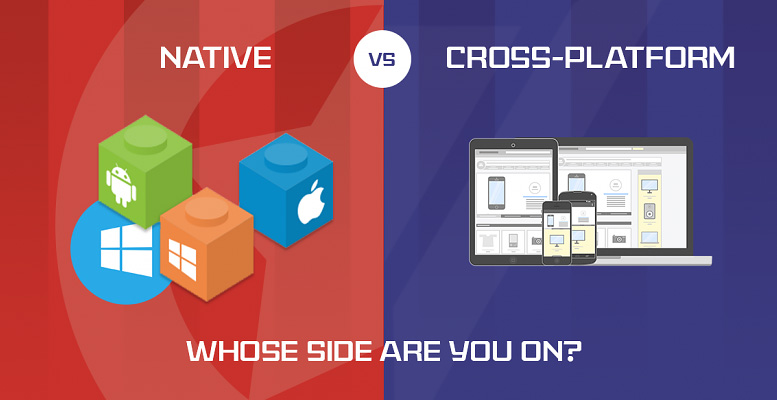
It is undeniable that mobile applications have become an integral part of our daily lives in the modern era. People are now using mobile apps for a variety of reasons, including accessing news and other information, shopping, gaming, and engaging on social media, thanks to the ever-increasing popularity of smartphone usage and mobile applications.
As a result, mobile app development companies are attempting to experiment in order to discover the best way to build a mobile app that not only looks great but also functions smoothly on various smartphones/devices.
Why is there a debate over Native vs Cross-Platform Apps?

With the ever-increasing competition between the Google Play Store and The Apple App Store, two of the world’s largest mobile application stores with a vast library of apps, determining which platform would best suit your app has become difficult.
If you want to create an app that only works on one of those two stores, you’ll need to create a completely new version for the other store. A cross-platform solution, on the other hand, aims to provide functionality in both of those stores with a single version of the app.
To put this into perspective –
- The Google Play Store has over 2.8 million apps, while the Apple App Store has over 1.9 million.
- The average smartphone user has 5-10 applications that they actively use.
- Google and Apple combined for over 218 billion app downloads last year!
These figures demonstrate the importance of applications in modern times. This is the primary reason why it is critical to understand what type of app you want to create.
Let us examine the benefits and drawbacks of the two types of mobile apps – Native and Cross-Platform – and compare them based on their specific function and requirements.
Native Apps

Native app development is done with a specific platform in mind. This frequently results in a more solid outcome in terms of results and timelines. You could argue that this is the ideal solution, but it is not within everyone’s financial means.
Advantages
- A native app is a much faster and more responsive option.
- Push notifications that offer a more engaging experience
- A very broad range of functionalities
- More likely to rank higher in-store searches
- Scalability is generally quite high.
Disadvantages
- The cost of native apps is higher due to the need to develop more than one version of the app to be offered on more than one platform (iOS & Android).
- The process is time-consuming because each platform must be started from scratch, and equal work in terms of development, testing, and project management must be assigned to each platform.
Cross-Platform Apps

Consider a cross-platform app as a more accessible option. This is ideal for those who do not want to invest heavily in development. Although this one-project-fits-all solution is very practical, it does have some drawbacks.
Advantages
- Because it is the same code that works on multiple platforms, it is significantly less expensive than native app development.
- The development process is faster, which translates to lower costs due to shorter development timeframes.
Disadvantages
- These apps are typically slower due to a lack of platform-specific optimization.
- Cross-platform apps have a more difficult time gaining access to various smartphone functionalities.
- When developing cross-platform apps, you do not have access to native UX components.
The major differences between Native and Cross-Platform Apps

- When a cross-platform mobile app development company is chosen, the task will be completed more quickly.
- Native applications take much longer to develop, but the end results are much superior.
- Cross-platform programming saves time, but it comes at the expense of reliability, speed, and hardware accessibility.
- When designing a cross-platform solution, the user experience suffers since you must consider various platforms while developing it.
The success of your mobile app is not solely dependent on which of the two platforms (native/cross-platform) you choose. Airbnb (cross-platform), Bloomberg App (cross-platform), Uber (cross-platform), WhatsApp (Native), Facebook (Native), and Spotify (Native) are just a few examples of companies that choose one of the two.
It’s vital to remember that, unlike cross-platform apps, a native app can be used on several platforms. However, the app creation process for each platform is separate.
Cross-platform apps use a single development process to ensure compatibility across multiple platforms.
Final thoughts
At the end of the day, deciding whether to go native or cross-platform involves a lot of thought. The best mobile app development services can make a significant impact in this process.
When looking for a reputable mobile app development business, keep this in mind. The outcomes you obtain regardless of your decision about the development team’s experience. achieve platform compatibility across several platforms

 Thansih SEO Analyst