What is Industry Analysis?

Starting a business that will be successful in the long run is a difficult task. It is critical to make the most of this process in order to achieve the best possible outcome.

According to statistics, roughly 20% of all new business ventures fail within the first 24 months. Only 25% of those who remain active life to the age of ten. The fundamental reason for this is that the project is not preceded by thorough industry analysis.

This implies that the majority of failed business ventures were doomed from the start. Most people do not conduct extensive research into the industry in which they wish to work. Clearly, this is a major blunder, and business owners must recognize the significance of industry analysis.

Opportunities in technology exist in a variety of industries.

Every day, we see how technology is transforming our world. From dating to grocery shopping, it’s difficult to imagine a facet of life that hasn’t been influenced by technology. That is to say, you would be equally well-served by investigating opportunities in modern healthcare, automobiles, retail, agriculture, or any other industry.

Here are some examples of technology opportunities in these industries:

Automotive: Vehicle connectivity with artificial intelligence and driving simulations in augmented reality.

Retail: Autonomous checkout systems in retail, augmented reality clothing stores, and artificial intelligence

Healthcare: Telemedicine that incorporates augmented and virtual reality features.

Agriculture: Farming software with GPS optimization and AI-powered moisture and temperature sensors.

How should an industry analysis be carried out?

Once you’ve made a decision, there are a number of steps involved in conducting an industry analysis. Begin by conducting a thorough background search on the industry or a subset of it, and then collect, analyze, and compare data to help answer market-related questions.

In addition, you should use the following commonly used and important methods to ensure a reliable outcome.

Competitive analysis

Within any industry, competition is always a factor. Analyzing the industry using one of the most famous models developed in 1980, also known as ‘Porter’s 5 forces,’ first introduced in Michael Porter’s book “Competitive Strategy: Techniques for Analyzing Industries and Competitors,” provides an acute impression of the industry and simplifies the analysis.

These five steps are as follows:

Industry rivalry intensity – The number of industry participants and their respective market shares are a direct reflection of the industry’s competitiveness. Lack of product differentiation tends to increase competition intensity. Exit costs that are prohibitively expensive, such as high fixed assets, government regulations, labour unions, and so on, make it more difficult for competitors to win.

Potential entrants – This shows how simple it is for new businesses to enter a specific industry’s market. Companies face a constant threat from new competitors if it is simple to enter an industry. When an entry is difficult, the firm with the smallest competitive advantage benefits for a longer period of time. When entering a difficult market, businesses must contend with a consistent set of competitors.

Supplier bargaining power – This refers to a supplier’s bargaining power. When an industry is reliant on a small number of suppliers, the suppliers wield considerable bargaining power. This is especially problematic for small businesses because it has a direct impact on the quality and pricing of the final product.

Buyer bargaining power – When customers have bargaining power, the outcome is the polar opposite. When consumers/buyers have bargaining power, they can negotiate lower prices, higher quality, or additional services and discounts. This is true in an industry with a larger number of competitors but a single buyer who accounts for a sizable portion of the industry’s revenue.

The threat of substitute goods/services – Because every industry’s products compete with similar substitute products from other industries, any firm within that industry will face competition from other industries, reducing profitability because it cannot charge exorbitant prices. It is possible to substitute two types of products: those of similar quality/function but lower cost, and those of the same price but higher quality.

PEST Analysis

The famous PEST analysis, also known as the ‘Broad Factors Analysis,’ stands for Political, Economic, Social, and Technological. To ensure that you have enough data, each of these aspects must be examined separately. This is an excellent framework for examining the industry.

Political: Understanding the political environment in your industry is critical for success. This entails learning everything you can about the legal policies and regulations that may affect your venture, such as taxes, labour laws, political stability, and so on.

Economic: Everything concerning economic growth, inflation, unemployment, interest rates, and so on. This will all have an impact on your business, and you must consider each factor.

Social: Factors relating to your company’s social impact. This includes cultural constraints, education level, customer demographics, behavioural trends, and overall lifestyle.

Technological: This is also important, as you must consider how technology will impact your business. The consequences could be both negative and positive, depending on the advancements and developments that change how a business operates and how people live their lives. The majority of the time, technology will be an advantage.

SWOT Analysis

SWOT analysis, like PEST, is a popular method of analysis. It is an acronym that stands for Strengths, Weaknesses, Opportunities, and Threats. This analysis is designed to ensure that all of your business decisions are calculated.

Strengths: Consider what strengths your company possesses and how those strengths are perceived by third parties, as well as what you do well and what distinguishes your company.

Weaknesses: It is critical to identify what your competitors are doing better and to match or exceed their performance. Recognize what your competitors are doing well in your current business strategy.

Opportunities: Identifying market opportunities, leveraging your strengths, and capitalizing on current trends are all critical components of your venture.

Threats: In addition to understanding how your competitors are affecting your business, you should examine the mistakes and threats that could have a negative impact over time.

The modern world is ruled by technology!

We live in a time when technology is the most relevant and powerful business tool available. It is critical that we learn to recognize this as the most important aspect of our modern-day strategies.

Software solutions that can be applied to any business problem are required for business solutions. A critical aspect of investing in useful technology is determining the best course of action to take in order to find the best solution to this problem. This could have a significant impact on a company’s competitive advantage.

Collaboration with a reputable software development firm

Choosing a reputable software development company is critical to getting your project off to a good start. It is critical to be able to obtain the appropriate advice to help you fine-tune your efforts.

Ensure that the development team you hire understands your industry. Furthermore, they should have prior experience working with start-ups to assist you in making the best decision. This type of project should ideally be handled by a team with relevant experience.

Finally, some thoughts on industry analysis.

When starting any type of business, there are numerous factors that must be considered. If you want your business to be successful in the long run, you should prioritize industry research.

Do you want to create the next big tech unicorn?

Here are some pointers to help you on your way!


We are seeing a significant increase in the number of startups being established each year, and the mere thought of starting a business worth $1 billion is likely to overwhelm you! However, it is certainly possible for a business idea to flourish to that extent.

In such cases, one of the first things you should think about is having a very specific plan in mind. It is much easier to get things moving once you have developed a solid strategy for achieving your goals.

In the year 2020 alone, 475 unicorns were born! According to statistics, more than 90% of startups fail, and only 40% of those that do survive become profitable enough to last.

1. Why should you pursue the tech domain for your start-up?

These statistics should not deter you from entering the startup world. Our goal is to promote better practices and careful planning in order to launch a successful business.

Now that we’ve gotten that out of the way, here are some key points to consider as you embark on your entrepreneurial journey!

Technology is everywhere, and getting involved in the tech industry may prove to be the wisest decision. In this niche, there is still a lot to learn.

We are at the start of what is shaping up to be the greatest change the world has ever seen. Stepping into the world of technology is the answer if you want to build a business with the potential to become a unicorn!

2. An examination of the industry

There are many industries that use technology today, and it is difficult to say which one is the best. This necessitates some preliminary research because there are numerous options such as transportation, communication, education, agriculture, retail, and so on.

You must take your time in order to make the best decision. Hesitation and last-minute changes are bad for a new business.

3. Validation of your idea and funding for your start-up

The goal here is to find answers to questions like, ‘Is there a large enough market for your business idea?’ or ‘Are people looking for the solution your idea will provide?’ and so on, in order to validate that your business idea will work. This can be accomplished by conducting interviews, brainstorming sessions, developing an MVP, and conducting surveys to gather customer feedback, to name a few methods.

A validated idea with potential will attract investors and secure funding. Checking investor portfolios to understand the types of technologies they invest in is one of the most important tasks you should complete.

4. Documentation and its significance

If you are serious about growing your business, documenting your ideas, plans, suggestions, and changes should be at the top of your priority list! Documentation should not be regarded as an option, but rather as a requirement. This will aid in the development of an actionable plan, the definition of standard procedures, the definition of roles, and, eventually, the raising of capital.

Standard operating procedures, Scope of Work, Licensing Agreements, and Confidentiality Agreements are just a few of the documents you’ll need.

5. Should I hire my own resources or use the services of a software solution provider?

This is determined by a number of factors that require your attention and consideration. To begin, you must decide how much you are willing to spend in-house versus how much you are willing to spend to hire a professional team that works remotely.

It is a time-consuming process in many ways, and you must consider numerous factors. It is critical to receive proper guidance on how to carry out these steps.

6. Selecting the Best Software Development Partner

Creating the best software product is a complex process that involves numerous precise interactions. And finding the right software development partner will be difficult. This choice has a significant impact on your ability to grow and prosper all the way to unicorn status.

7. Advantages of an On-shore vs. Off-shore Software Firm

There are numerous advantages and disadvantages to using a local software company or an offshore company to complete your work. Before making that decision, you must consider a number of factors.

8. Things to think about when designing and developing a website or mobile app

The costs are one of the most important aspects of any software development and design process. Having said that, time is another important factor to consider in software development if you want to succeed.

Similarly, there are several other factors that would need careful consideration prior to kick-starting your website or mobile app development.

9. The cost of creating a mobile or web app

In most cases, website development at a low level with simple features is very affordable. The high-end software development costs, on the other hand, are a completely different story. This is why it is critical to collaborate with the right mobile app development team.

10. What is the difference between native and cross-platform apps?

Without going into specifics, native apps are built specifically for one operating system and are intended to be used on specific devices, whereas cross-platform apps are written once and can be used on multiple platforms.

The budget is the most important consideration here. Whether you can expect a mobile app to be developed within the budget you have set. Every alternative will have advantages and disadvantages; you simply need to consider the big picture and understand the goals you want to achieve.

11. The significance of developing a secure web / mobile app

Safety appears to be the most important concern in the digital era, which makes sense given the dangers of data and identity theft, as well as cybercrime in general. As a result, developing a secure website and mobile app is critical in any project.

The best way to ensure a successful development process is to select a development team that is extremely efficient when it comes to dealing with security issues.

12. The Importance of User Experience in Web app/Mobile App Development

This is a critical component of any app’s development, but it appears to be overlooked in the majority of projects. The user experience determines how smooth, seamless, and intuitive navigation and browsing are for users, making it an important factor to consider when developing your mobile/web application.

13. The amount of time required to create/develop web and mobile apps

Mobile apps and websites with a high level of complexity will not come together in a matter of days. Instead, they can take several months, if not more than a year, to complete!

As previously stated, it is critical to consider the entire time frame for a project. This will also reveal the project’s estimated costs.

14. Challenges to be aware of while developing your mobile app

When you engage in the process of app development, there will always be challenges and roadblocks. Whether you choose to work with an in-house or an external team, you will face challenges.

The best way to deal with this is to be aware of such situations and to have the right kind of guidance on how to overcome these obstacles.

15. SEO and the significance of developing an SEO-friendly website!

According to industry experts, content is still king, which is something to think about. The foundation of a successful SEO (Search Engine Optimization) campaign is high-quality content.

In this situation, there are numerous factors to consider, such as the quality of the content, the target audience, the optimization of the text you publish, and so on.

16. What is SMM (Social Media Marketing), and how can it benefit your company?

Social media has evolved into one of the most effective tools for anyone seeking to reach their target audience. As we approach Web 3.0, social media is becoming an ever more complex and crowded phenomenon.

Having the ability to use social media for marketing purposes will be critical to your success.

17. Establishing a user base

The development of a user base for an application is just as important as the development of the web/mobile app itself. It is pointless to create an app or website if no one visits or uses it.

Understanding the most efficient and effective ways to build a strong user base for your app and website is critical to your success.

18. Keeping users engaged with your mobile or web app

Once you have attracted new users to your website or mobile application, you must consider how to keep them.

This factor will be equally important to your long-term success.

Finally thoughts

Each of the preceding steps is complex in its own right, and it is critical to understand this before proceeding. Learning the specifics of how to handle each of these is a critical component of your business strategy.

These are the points we’ve highlighted to make you aware of the tasks that will be involved in your journey to create a tech unicorn. In the future, we will delve deeper into each point to better understand the complexities involved.

Now that you have a better understanding of the steps involved, why not begin evaluating the best approach for your project?

How Innobayt helped a lubricant manufacturer enhance its operational efficiency

Innovation through automation – Innobayt’s custom solutions helped enhance the operational efficiency of a lubricant manufacturer through interconnecting systems and IoT integration.

Operational inefficiencies stemming from manual processes and other sources were a huge challenge for a global lubricant manufacturer. Innobayt successfully leverage IoT software development and smart sensors to deliver a robust custom middleware that streamlined the production process and connected their legacy systems that worked in silos. The changes addressed most of the productivity issues in the manufacturing process by minimizing human intervention, automating the processes, and centralizing all data.

About the client

Innobayt’s client is a leading manufacturer of industrial and automotive lubricants and is well-known for its commitment to quality, safety, and sustainability. Today, the lubricant manufacturer operates in more than 130 countries and has multiple R&D centers that continuously develop innovative and efficient products for its customers. The client has been around in the market for a significant time and is the go-to lubricant choice for automotive, marine, industrial machinery, aviation, and many other industries.

Challenges faced by the client:

The client’s production process before Innobayt’s involvement was full of inconsistencies and challenges. They understood that manual and siloed processes were the main sources of inefficiencies in the system and approached Innobayt to develop an effective solution. Before discussing the changes by Innobayt, it’s relevant to take a brief look at the original operations.

The targeted production line started at the filling lines where bottles were prepared by filling them with the appropriate lubricant. After this, the prepared bottles were then sorted into cartons on a conveyor belt.  A laser printer was then used to print details such as product name, batch number and production date on a label which was then applied manually on cartons.

After the manual labelling process, the cartons passed through a quality control system that accepted or rejected them based on their weight. The accepted cartons were then placed on palettes by a robotic arm, which was wrapped for safety and picked up for subsequent storage and delivery.

The existing process was highly unsatisfactory in terms of operational efficiency and overall productivity. The client faced several challenges and most of them originated from the following 5 sources.

1 – Disconnect between system operations

The previous process consisted of multiple moving parts that operated independently. The production line contained a lot of legacy equipment, used multiple data processing systems, and had no synergy due to little or no collaboration. This lack of centralization created several problems as there were no actionable data or insights from the production setup for helping with decision-making and thereby reducing the possibility to introduce a meaningful change.

2 – Inefficiencies due to manual processes

The assembly line relied on manual intervention at several stages. Starting from the entry of records to the verification of content and the removal of rejected cartons, every step required human intervention which resulted in a lot of inefficiencies.

3 – Lack of real-time data

Decentralization of data and reliance on manual processes also affected the client’s ERP system’s ability to provide essential data when required. Inventory levels, production output, and other important parameters were scattered across multiple systems like SAP, MS Excel, emails, etc. This meant that no one at the plant had a holistic view of the operations at a given time which made their decision-making process quite tedious and less effective.

4 – Frequent production stoppages

The client also dealt with the issue of frequent production stoppages due to manual intervention. This had been significantly affecting their production efficiency and was one of the major challenges that they wanted to address. Effectively reducing these stoppages was quite difficult because of the lack of accountability and inadequate tracking. The client also had a very limited number of viable options to reduce manual intervention without compromising on other essential parameters.

5 – Little to no tracking of rejections and removals

As reiterated multiple times, most of the client’s challenges were due to inefficient and legacy systems. As the data collected from various stages of the product line were decentralized, it made it difficult to track the rejections and removal of cartons from the production line. This led to discrepancies in inventory, production records, and other essential records.

How did Innobayt help?

Innobayt started its process by developing a better understanding of the client’s pain points. Innobayt held multiple workshops and interviews with the concerned teams and the management. Once the expectations were clarified, Innobayt’s experts developed a comprehensive middleware solution designed to target production efficiency by allowing all the existing systems to work synchronously and thereby allowing them to operate at their full potential.

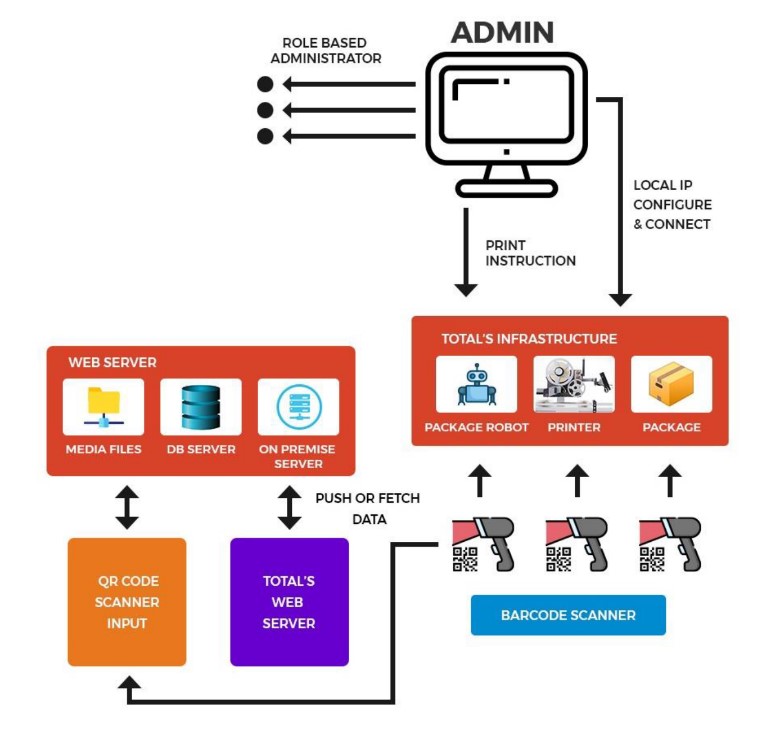
The automated system consisted of a customized middleware that connected all previously siloed systems that were in place such as roller conveyor, weight rejector, label printer, robotic arm etc. Innobayt adopted a five-pronged approach that minimized human input through automation and ensure optimal performance with consistency.

1 – Automation of the sorting process

Innobayt automated the entire sorting process from the conveyor belt to final pelleting. API and PLC based integration allowed the different equipment for printing, rejection, robotic arm and scanning to work together and eliminate the need for any manual oversight.

The offline printing model with manual data entry was replaced with an integrated system that pulled information directly from the client database (SAP) for printing. Innobayt also upgraded the carton and pallet printers, added advanced sensors (SICK photosensor), scanners (ZEBRA QR code scanner, Datalogic QR code scanner) and created an interlinked system with the capability to process and analyse data in real-time.

2 – Enhanced control and transparency over operations

One of the main problems the client faced due to data decentralization was the ineffective tracking of production output and inventories. No one knew how many cartons were rejected or why. This discrepancy in data made it difficult to introduce any improvement in the process and had the potential to result in inaccurate reporting for the client.

Innobayt used a combination of industrial photosensors and QR code scanners to eliminate this issue. Each carton and pallet were assigned a unique code that could be used to track the contents and the location of the carton. Innobayt built a unified web portal that could be accessed by all stakeholders (with role-based access control) that provided access to real-time data enabling the system to be more reliable based on which the client could make informed decisions.

3 – Remote management capabilities

With the custom-developed admin panel, not only was the client able to keep an eye on all essential parameters and production processes but they could also start, stop and maintain control over the operations by accessing the middleware through the web.

4 – Integration of legacy equipment with IoT based middleware

Any automation system remains incomplete if the legacy systems are unable to interact with the new IoT infrastructure properly. Innobayt improved the weight rejector system by using a PLC to connect its middleware with the legacy setup. This allowed the client to track the rejected cartons and sort them out separately without interrupting operations.

5 – Uninterrupted production through proactive and reactive maintenance support

Innobayt’s services did not just end upon the completion of the development and installation of the customized solution. A proactive and reactive maintenance plan was also developed to ensure the consistency and reliability of the delivered solution.

Summary: Innobayt’s innovative approach successfully revamped the client’s production operations

The client approached Innobayt with an inefficient system unable to perform to its full potential. Different systems worked in silos and required consistent human intervention to operate. Innobayt’s middleware bridged the gap between the client’s hardware and operation systems to fully automate the production process and synergize its output for enhanced productivity and efficiency.